Today we drive the most exciting part of the Pacific Coast Highway. Its only about 3 hours (hopefully) of driving, but it will be a long day with stops and we have timed tickets for Hearst Castle near the end of the day so we have to stay on schedule.
Catch the highlights of what we will see on this
video.
First, we pass through Carmel-by-the-Sea (home of Clint Eastwood and Doris Day). Lots of art galleries and glitz but we will just pass through probably stopping only to see the Carmel Mission. The Carmel Mission was the
most important of all the California missions, serving as home,
headquarters, and final resting place of Father Junipero Serra, the
Franciscan priest who established Carmel and many of the 20 other
California missions.
The mission, first established on June 3, 1770, in nearby Monterey, (near the native village of Tamo), was named for Charles Borromeo, Archbishop of Milan, Italy. In May, 1771, the viceroy approved Serra's petition to relocate the
mission to its current location near the present-day town of
Carmel-by-the-Sea. In 1794, the population reached its peak of 927, but by 1823 the total had dwindled to 381. On November 20, 1818, French privateer Hipólito Bouchard
raided the Monterey Presidio, before moving on to other Spanish
installations in the south. The mission was in ruins when the Roman
Catholic Church regained control of it in 1863. In 1884 Father Angel
Casanova undertook the work of restoration. In 1961,
the mission was designated as a minor basilica by Pope John XXIII.
As a result of Downie's dedicated efforts to restore the buildings, the
Carmel mission church is one of the most authentically restored of all
the mission churches in California. In 1987, Pope John Paul II visited the mission as part of his U.S. tour.
Stretching 90 miles south of Carmel from Point Lobos all
the way to Hearst Castle, Big Sur is one of the most memorable sections
of coastline on the planet, with 5,000-foot-tall mountains rising up
from the Pacific Ocean. Early Spanish missionaries dubbed it El País
Grande del Sur, the “Big Country of the South,” and the rugged land has
resisted development or even much of a population—the current total of
around 1,500 is roughly the same as it was in 1900. The highway was finally cut across the very steep cliffs in 1937 after 20
years of convict labor and several fatalities. Named the state’s first
scenic route, so dedicated by Lady Bird Johnson in 1966, it’s an
incredible trip. In 1983, the biggest storm in recent memory closed the
road for over a year, and in 1998, 70 miles of it were blocked for over
four months; sections of it are closed almost every year.
The Bixby Creek Bridge, constructed in 1932 and, thankfully, seismically retrofitted in 1996 is one of the most photographed sites along the way. While it looks fragile, its designed to hold six times its expected weight.
 |
| Trees |
Roughly a half mile south of Big Sur village is Pfeiffer–Big Sur State
Park. This beautiful park features redwoods, conifers, oaks, sycamores,
cottonwoods, maples, alders and willows - plus open meadows. Wildlife
includes black-tail deer, gray squirrels, raccoons, skunks, and birds,
such as water ouzels and belted kingfishers.
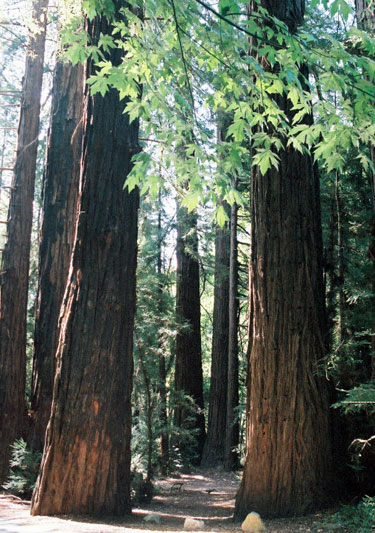
We need to see some redwoods! Diana thinks these pictured here are big enough.
 |
| Nepenthe |
One
of the most popular and long-lived stopping points along the Big Sur
coast,
Nepenthe is a rustic bar and restaurant offering
good food and great views from atop a rocky headland a thousand feet
above the Pacific. The hilltop where Nepenthe now stands was previously
the site of a rustic cabin that Orson Welles bought for his wife, Rita
Hayworth, in 1944. Named for the mythical drug that causes one to forget
all sorrows, Nepenthe looks like something out of a 1960s James Bond
movie, built of huge boulders and walls of plate glass.

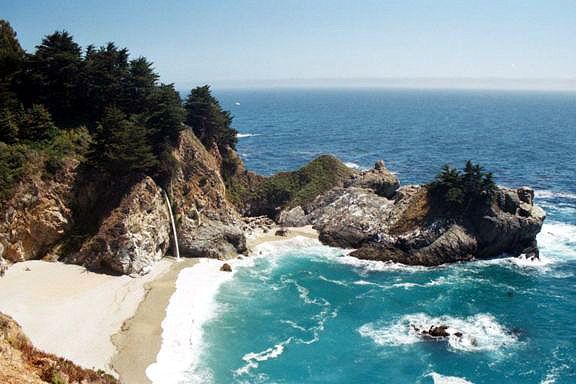
Julia Pfeiffer Burns State Park includes one truly beautiful
sight: a slender waterfall that drops crisply down into a nearly
circular turquoise-blue cove. This is the only waterfall in California
that plunges directly into the Pacific. From the parking area, east of the
highway, a short trail leads under the road to a fine view of the
waterfall, while another leads to the remnants of a pioneer mill,
complete with a preserved Pelton wheel. Other routes climb through
redwood groves up to the chaparral-covered slopes of the Santa Lucia
Mountains.

At the south end of Big Sur, the mountains flatten out
and turn inland, and the coastline becomes rolling, open-range ranch
land. High on a hill above Hwy-1 stands the coast’s one totally unique
attraction,
Hearst Castle. Located 65 miles south of Big Sur village ,
Hearst Castle is the sort of
place that you really have to see to believe, though simple numbers—144
rooms, including 36 bedrooms—do give a sense of its scale. Hearst spent
25 years working on his “castle,” building, rebuilding, and filling room
after room with furniture. Its the second most visited site in California after Disneyland.
Hearts inherited the land from his father George, who struck it rich in mining in South Dakota (we visited his mine). They have a number of different tours, you only get to see a few things on each tour. We're taking the introductory tour which gets us into a few of the main rooms.
 |
| Indoor Pool |
 |
| Outdoor Pool |
 |
| Library |
 |
| Dining Hall |
 Just north of San Simeon, there is an elephant seal rookery at Piedras Blancas. Hunted
nearly to extinction for their oil-rich blubber, elephant seals have
made a remarkable comeback. Protected by the Marine Mammal Protection
Act, they are expanding their range outward from remote islands and are
now colonizing selected mainland beaches such as Piedras Blancas in the
southern range of Big Sur, near San Simeon.n
the 1880's northern elephant seals were thought to be extinct, harvested
by shore whalers and sealers for their blubber. The oil obtained from
elephant seals is second in quality only to the sperm whale. A small
group of between 20-100 elephant seals that bred on Guadalupe Island,
off Baja California, survived the ravages of the seal hunts. Protected
first by Mexico and later by the United States, they have steadily
expanded their range. Today they are protected from hunting and
harassment by the Marine Mammal Protection Act of 1972.
Just north of San Simeon, there is an elephant seal rookery at Piedras Blancas. Hunted
nearly to extinction for their oil-rich blubber, elephant seals have
made a remarkable comeback. Protected by the Marine Mammal Protection
Act, they are expanding their range outward from remote islands and are
now colonizing selected mainland beaches such as Piedras Blancas in the
southern range of Big Sur, near San Simeon.n
the 1880's northern elephant seals were thought to be extinct, harvested
by shore whalers and sealers for their blubber. The oil obtained from
elephant seals is second in quality only to the sperm whale. A small
group of between 20-100 elephant seals that bred on Guadalupe Island,
off Baja California, survived the ravages of the seal hunts. Protected
first by Mexico and later by the United States, they have steadily
expanded their range. Today they are protected from hunting and
harassment by the Marine Mammal Protection Act of 1972.
Elephant
seals began hauling out on a secluded beach just south of the
lighthouse in 1990. It was an extraordinary occurrence that delighted
the public traveling Highway 1 north of San Simeon.
By the end of the 1880’s they were thought to be extinct. Whalers and
sealers had hunted them for their blubber. A small colony, between 20
to 100 individuals managed to survive and took up residence on Guadalupe
Island, off Baja, California.
All of the elephant seals on the West Coast of the continent are descended from this group.
Some elephant seals are always present at Piedras Blancas, but the
most interesting time to visit is during breeding season from November
through February. Beaches are jammed with chubby females giving birth,
little black pups
suckling, and huge blubbery males doing battle.
Male seals begin to arrive in late November and stake out their
positions on the beach. Dominant bulls, the ones that have the best
chance to mate with the most females, threaten away lesser males and
take up residence waiting for the females to arrive.
One of the most exciting things to witness is a battle between two of
these large bulls. When approached by another male, the resident bull
will rear up on his hindquarters, throw his head back, and roar out a
threat. His large bulbous nose dips down into his gaping mouth. Then
each bull rears up and with great force they slam their bodies at each
other, slashing away with their large canine teeth. Fights can last a
few minutes or go on for hours. Usually the battle ends with one bull
being forced into the water or backing away submissively.
Pregnant females arrive on the beaches in December and, after four or
five days, give birth to one pup that arrives thin, wrinkled and black.
Most pups begin to suckle soon after birth. Elephant seal milk is the
richest of all mammals with a high percentage of fat. The pups gain
weight quickly on this, doubling and quadrupling their size in less than
a month.
Nursing lasts for about 28 days. In the last three to five days the
females are ready for breeding. Now the alpha bull takes advantage of
his position to mate with the most females. Within a month after giving
birth, females are impregnated. A little more than a month after
arriving at the rookery, the female heads out to sea leaving her now
plump, molting pup on shore.
- See more at: http://www.slovisitorsguide.com/Cambria-San-Simeon/visit-the-elephant-seals.html#sthash.LMf9Y4ym.dpuf
Elephant
seals began hauling out on a secluded beach just south of the
lighthouse in 1990. It was an extraordinary occurrence that delighted
the public traveling Highway 1 north of San Simeon.
By the end of the 1880’s they were thought to be extinct. Whalers and
sealers had hunted them for their blubber. A small colony, between 20
to 100 individuals managed to survive and took up residence on Guadalupe
Island, off Baja, California.
All of the elephant seals on the West Coast of the continent are descended from this group.
Some elephant seals are always present at Piedras Blancas, but the
most interesting time to visit is during breeding season from November
through February. Beaches are jammed with chubby females giving birth,
little black pups
suckling, and huge blubbery males doing battle.
Male seals begin to arrive in late November and stake out their
positions on the beach. Dominant bulls, the ones that have the best
chance to mate with the most females, threaten away lesser males and
take up residence waiting for the females to arrive.
One of the most exciting things to witness is a battle between two of
these large bulls. When approached by another male, the resident bull
will rear up on his hindquarters, throw his head back, and roar out a
threat. His large bulbous nose dips down into his gaping mouth. Then
each bull rears up and with great force they slam their bodies at each
other, slashing away with their large canine teeth. Fights can last a
few minutes or go on for hours. Usually the battle ends with one bull
being forced into the water or backing away submissively.
Pregnant females arrive on the beaches in December and, after four or
five days, give birth to one pup that arrives thin, wrinkled and black.
Most pups begin to suckle soon after birth. Elephant seal milk is the
richest of all mammals with a high percentage of fat. The pups gain
weight quickly on this, doubling and quadrupling their size in less than
a month.
Nursing lasts for about 28 days. In the last three to five days the
females are ready for breeding. Now the alpha bull takes advantage of
his position to mate with the most females. Within a month after giving
birth, females are impregnated. A little more than a month after
arriving at the rookery, the female heads out to sea leaving her now
plump, molting pup on shore.
Bull elephant seals fight over territory on the seashore north of Cambria
- See more at: http://www.slovisitorsguide.com/Cambria-San-Simeon/visit-the-elephant-seals.html#sthash.LMf9Y4ym.dpuf
Elephant
seals began hauling out on a secluded beach just south of the
lighthouse in 1990. It was an extraordinary occurrence that delighted
the public traveling Highway 1 north of San Simeon.
By the end of the 1880’s they were thought to be extinct. Whalers and
sealers had hunted them for their blubber. A small colony, between 20
to 100 individuals managed to survive and took up residence on Guadalupe
Island, off Baja, California.
All of the elephant seals on the West Coast of the continent are descended from this group.
Some elephant seals are always present at Piedras Blancas, but the
most interesting time to visit is during breeding season from November
through February. Beaches are jammed with chubby females giving birth,
little black pups
suckling, and huge blubbery males doing battle.
Male seals begin to arrive in late November and stake out their
positions on the beach. Dominant bulls, the ones that have the best
chance to mate with the most females, threaten away lesser males and
take up residence waiting for the females to arrive.
One of the most exciting things to witness is a battle between two of
these large bulls. When approached by another male, the resident bull
will rear up on his hindquarters, throw his head back, and roar out a
threat. His large bulbous nose dips down into his gaping mouth. Then
each bull rears up and with great force they slam their bodies at each
other, slashing away with their large canine teeth. Fights can last a
few minutes or go on for hours. Usually the battle ends with one bull
being forced into the water or backing away submissively.
Pregnant females arrive on the beaches in December and, after four or
five days, give birth to one pup that arrives thin, wrinkled and black.
Most pups begin to suckle soon after birth. Elephant seal milk is the
richest of all mammals with a high percentage of fat. The pups gain
weight quickly on this, doubling and quadrupling their size in less than
a month.
Nursing lasts for about 28 days. In the last three to five days the
females are ready for breeding. Now the alpha bull takes advantage of
his position to mate with the most females. Within a month after giving
birth, females are impregnated. A little more than a month after
arriving at the rookery, the female heads out to sea leaving her now
plump, molting pup on shore.
Bull elephant seals fight over territory on the seashore north of Cambria
- See more at: http://www.slovisitorsguide.com/Cambria-San-Simeon/visit-the-elephant-seals.html#sthash.LMf9Y4ym.dpuf
 |
| Hotel Perched on a Cliff Above the Beach |
After Hearst Castle we'll drive through the towns of
Cambria and
Morro Bay before stopping for the night in Pismo Beach. They hotel room will have more than twice the space for about haft the price of the one in Monterey.
 |
| View from the Hotel |
.